To Steno (Το Στένο) means a strait, a pass or narrow, and To Steno, the kafeneion in the side lane in Yialos, fits that bill perfectly, though it could also be called an art gallery. Every table and wall is painted by hand by the owner’s daughter and/or her mother in law, and shows a Symi scene or other Greek view, oranges, a ship etc. You have your drinks off a piece of art, basically.
You also have an interesting, yet simple menu. You can take an ouzo and have some mezethes (small plates of various dishes) or, if there are two or three of you, you can have a meze plate for €20.00 for six dishes. There is also a €50.00 option for six people – if you are a party of four or five you will have to do your own calculations. The food is homemade and some of it comes from the family farm up towards Tolis on the north west of the island, where they have six pigs, sheep, goats and grow potatoes, among other things. So, it’s all fresh and made with love and care. We had, in our €20.00 plate, gigantes, aubergine, beetroot and garlic sauce, yoghurt, bread, fava and chicken drumsticks.
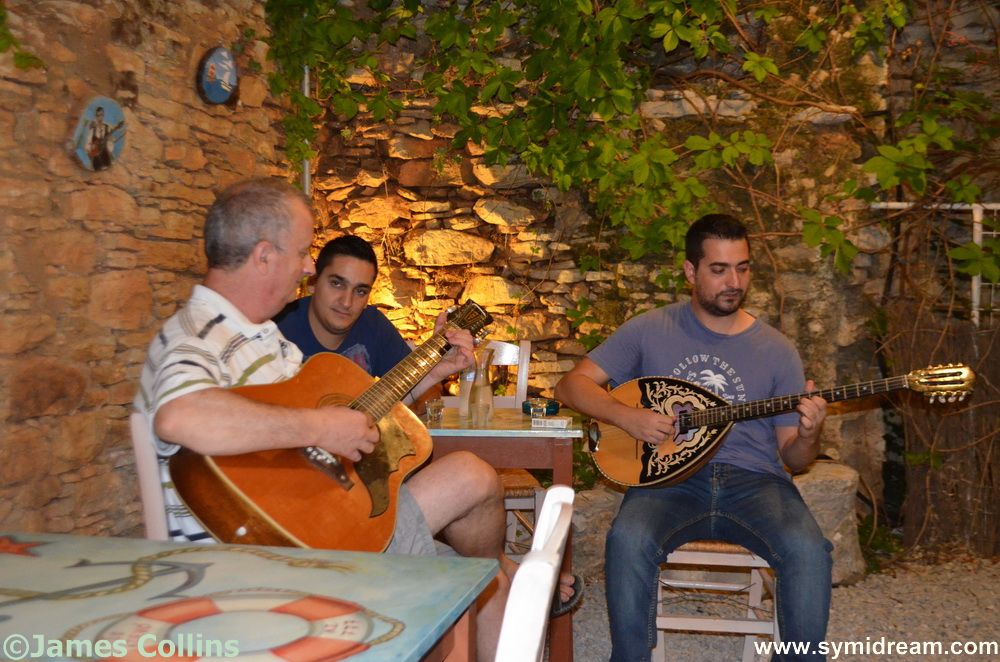
While we were there, early in the evening, we were treated to some bouzouki music and guitar, again provided by the family, and this music can go on well into the night, with impromptu dancing included as well. If you want the traditional Greek ‘thing’ this this is it. It’s taken us a while to getting around to going there but we’ll be back. It’s in the lane between the harbour front at ‘comfy chairs’ and the church square. You have three lanes heading from sea to backstreet in Yialos, one with Symi Tours in it, one with Taxas supermarket at the end, and the one in the middle, this one. You’ll find it.

Here’s a thing about the bouzouki (according to an online dictionary): “The bouzouki (also buzuki) (Greek: μπουζούκι pronounced [buˈzuci]; plural: μπουζούκια) is a Greek musical instrument that was brought to Greece in the 1900s by Greek immigrants from Asia Minor, and quickly became the central instrument to the rebetika genre and its music branches. A mainstay of modern Greek music, the front of the body is flat and is usually heavily inlaid with mother-of-pearl. The instrument is played with a plectrum and has a sharp metallic sound, reminiscent of a mandolin but pitched lower. There are two main types of bouzouki. The trichordo (three-course) has three pairs of strings (known as courses), and the tetrachordo (four-course) has four pairs of strings.”

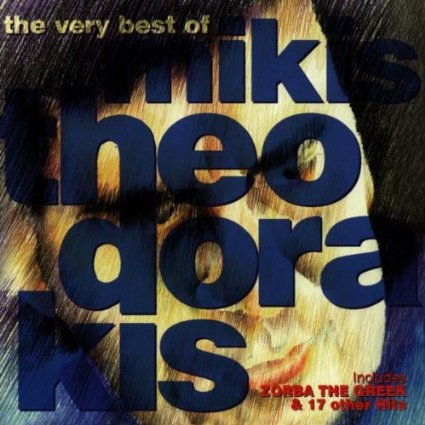
My Collins Encyclopaedia of Music adds that, ‘The bouzouki enjoyed a great revival in the 1960s when several Greek composers, notably Mikis Theodorakis, exploited the sound of the instrument and made it known internationally.’ So, if you were thinking it was an ancient Greek instrument, think again, it’s a relatively modern one and yet one that is now so typically Greek. There you are, the things you learn when you stop off for a small plate. And if you wanted to hear some Theodorakis and have some authentic Greek music in your home, here’s an idea for a CD. (Click pic to link)