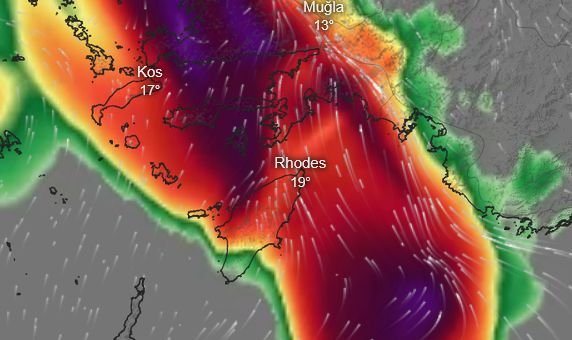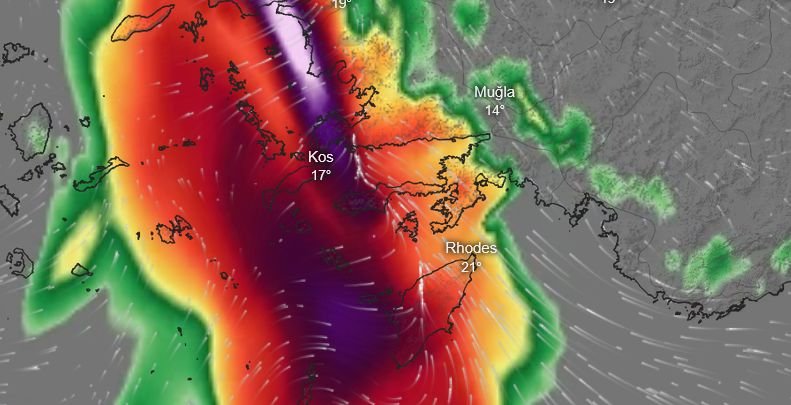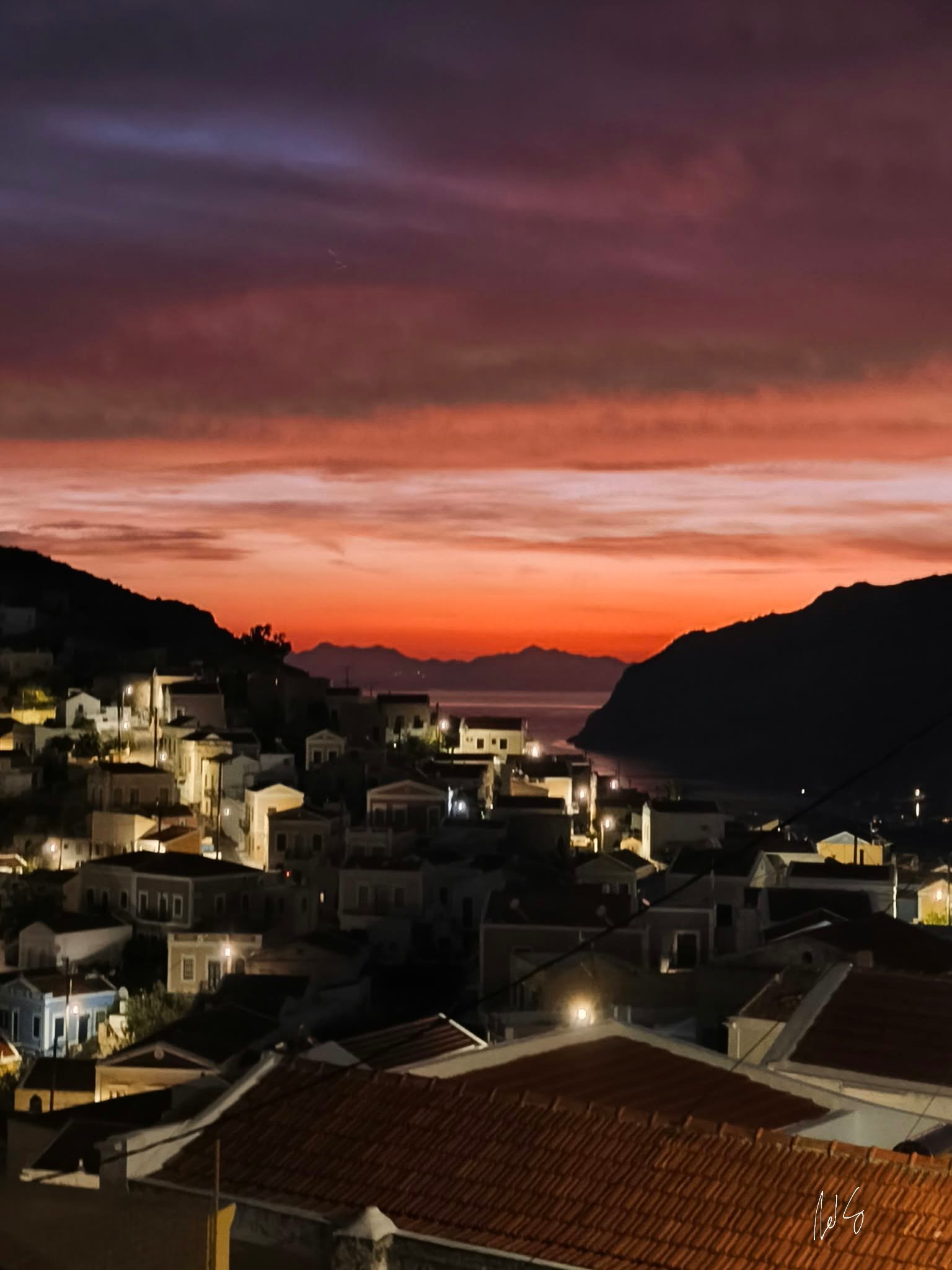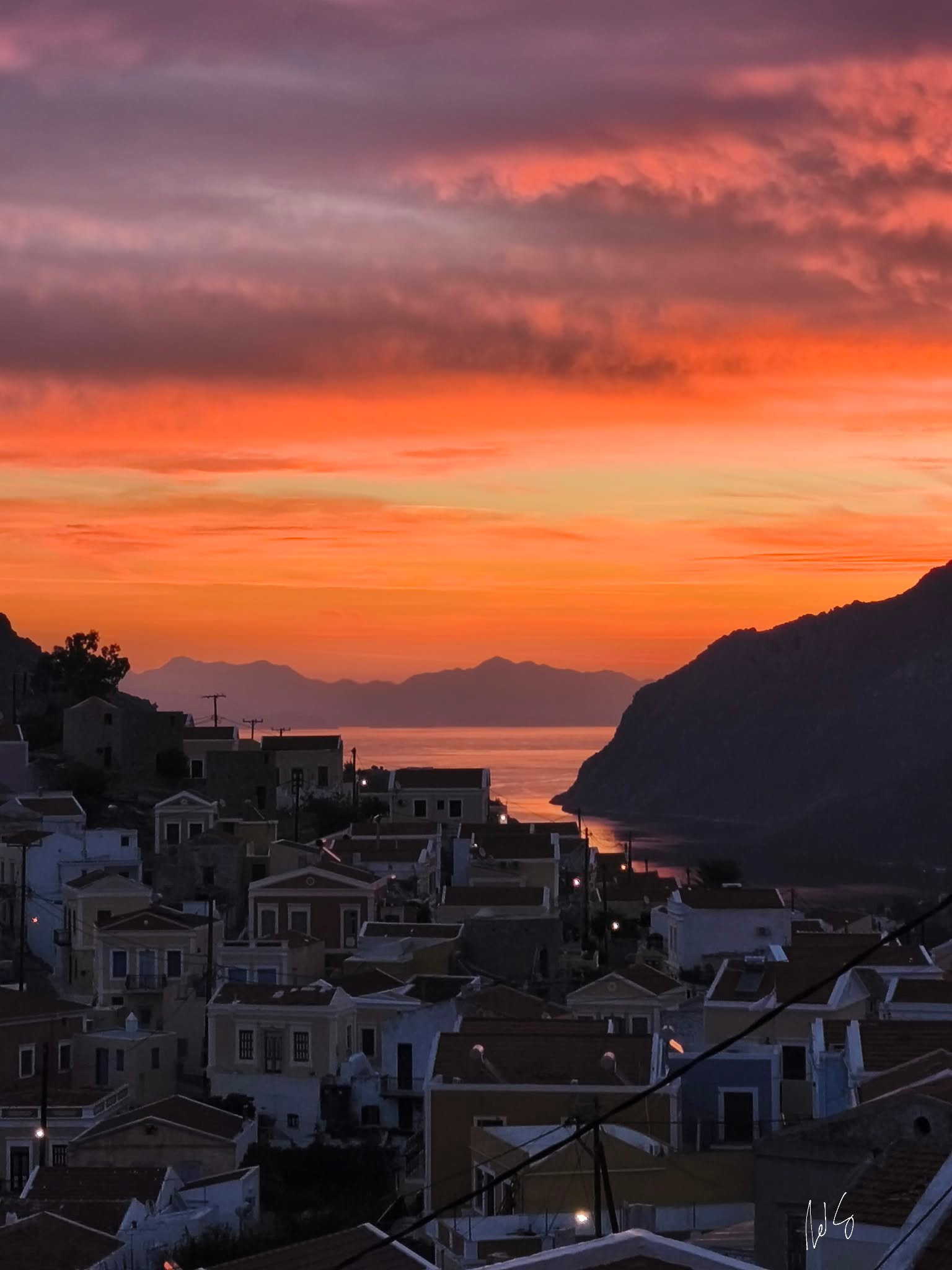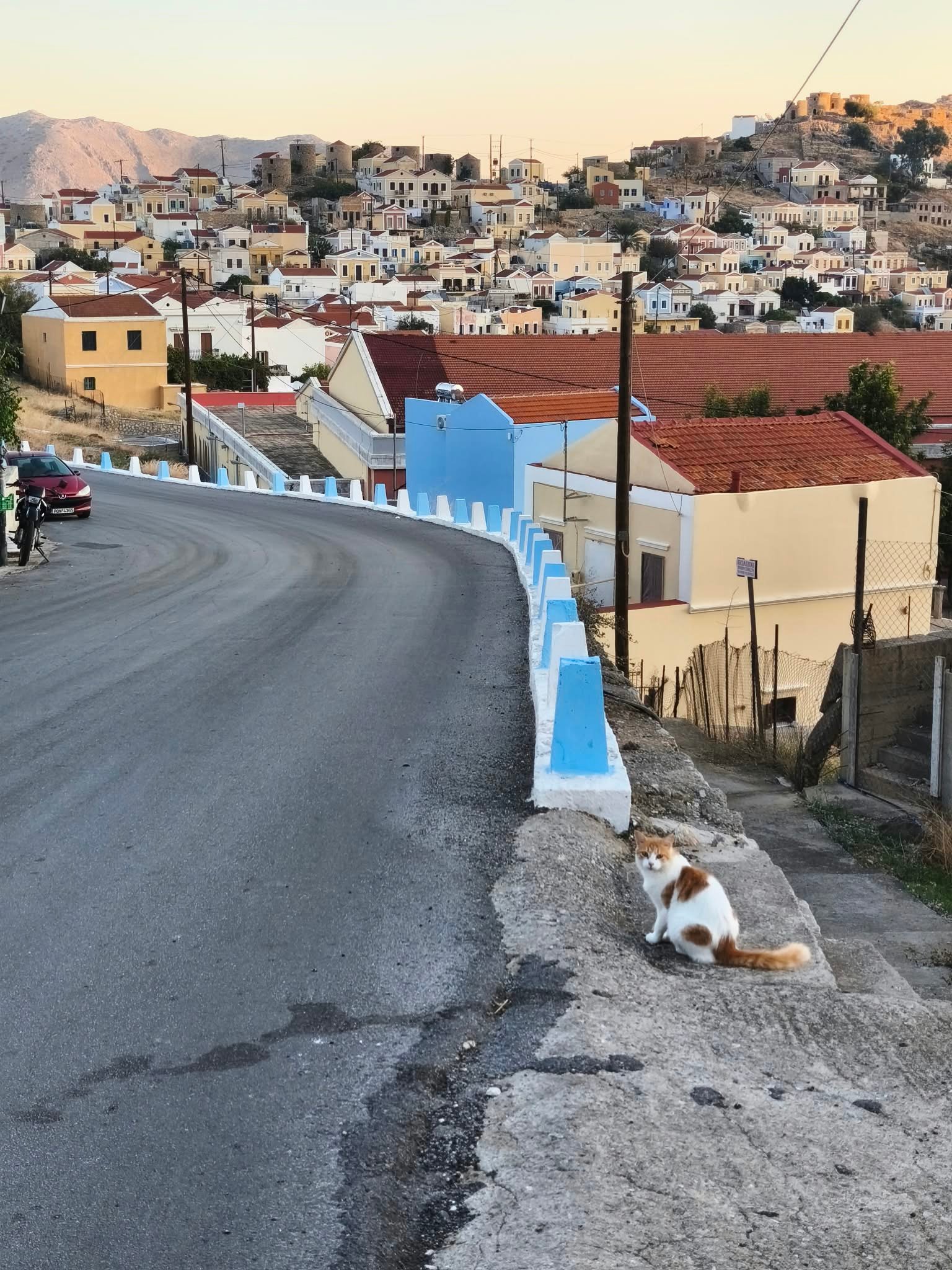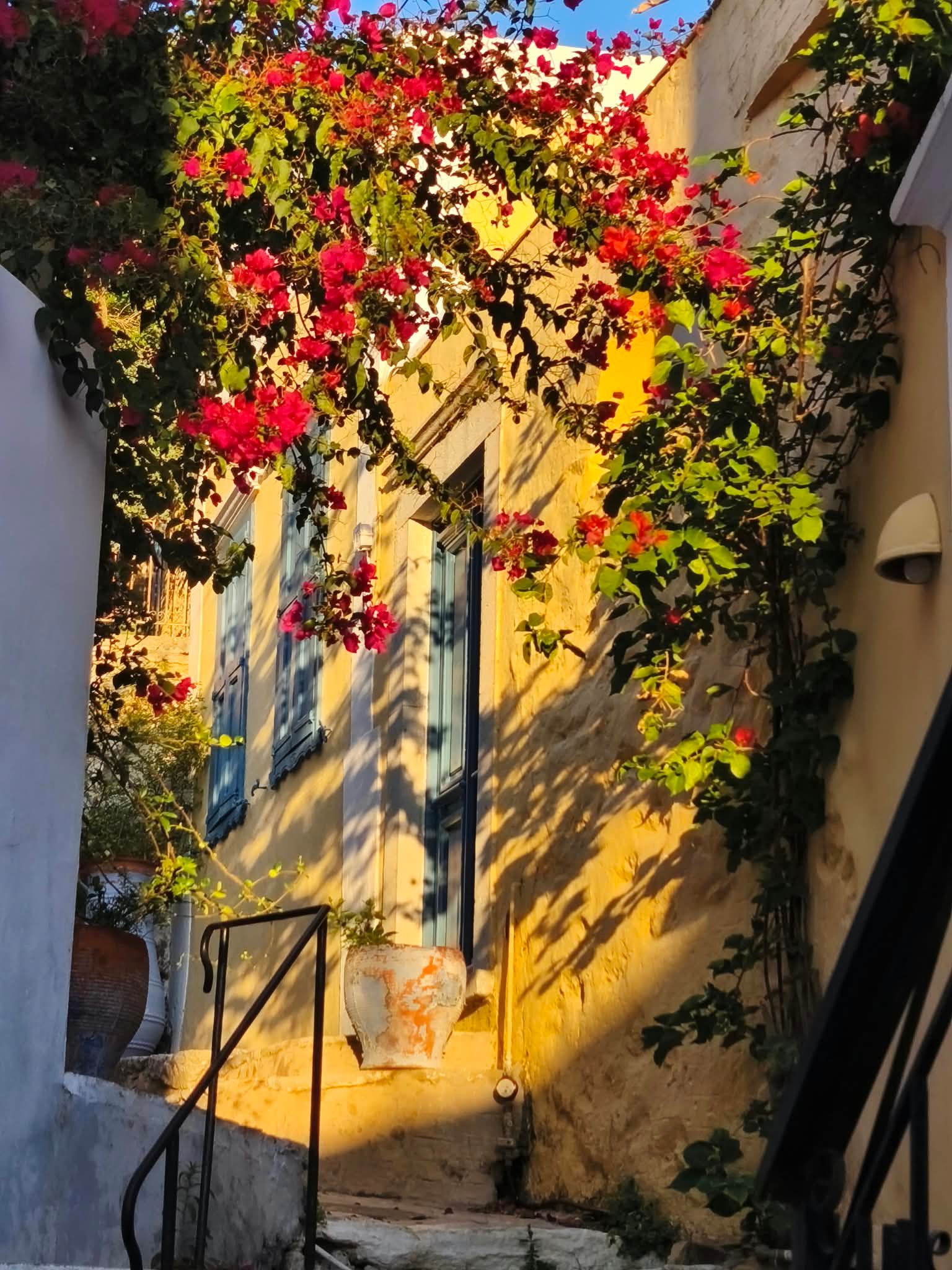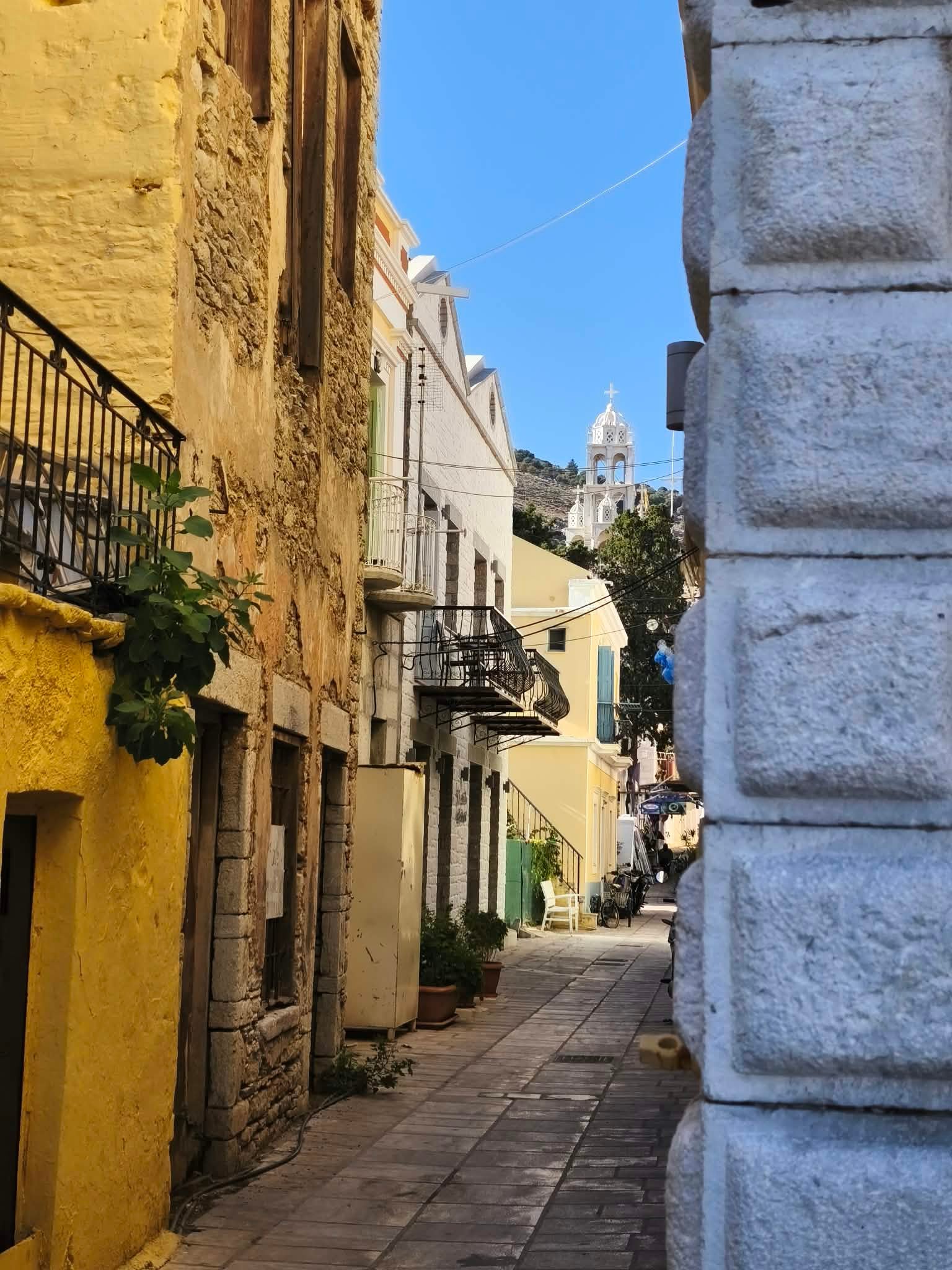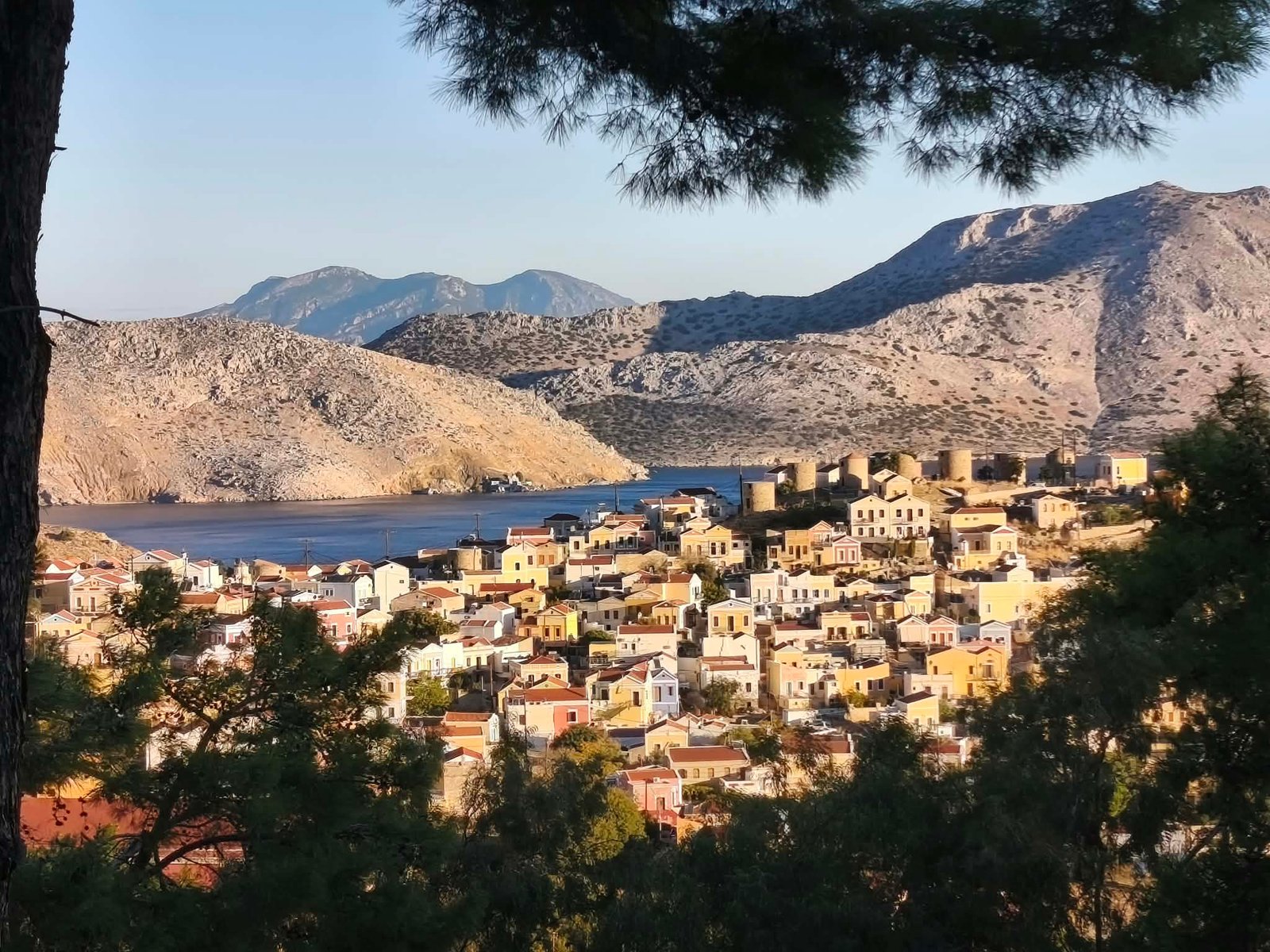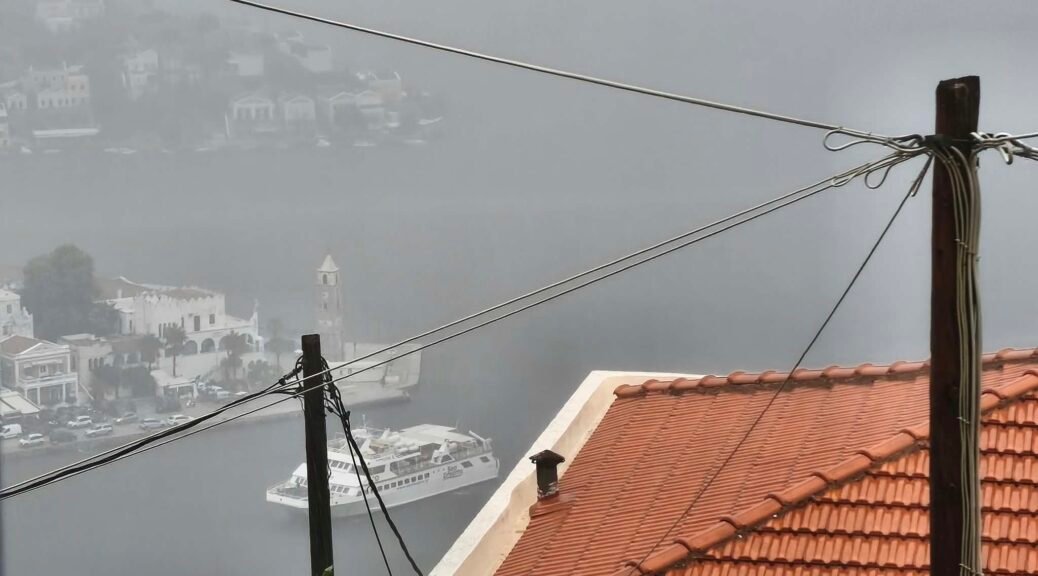
Something of a windy day yesterday. The open shutters battling against the rocks that hold them open, kitchen windows, even when closed, rattling unless a stone pestle and mortar is pushed up against them and even then, not always successful. A variety of foliage blowing in from the Windy City; dead vine leaves scuttling across the floor, bougainvillea flowers, unspecified pieces of someone else’s garden, even the odd plastic big bag coming in over the wall. V-shaped twigs from the tree next door. In the shape of divining rods, they cling to the broom bristles, and fox the vacuum cleaner, and appear in tedious abundance all year round, it seems.
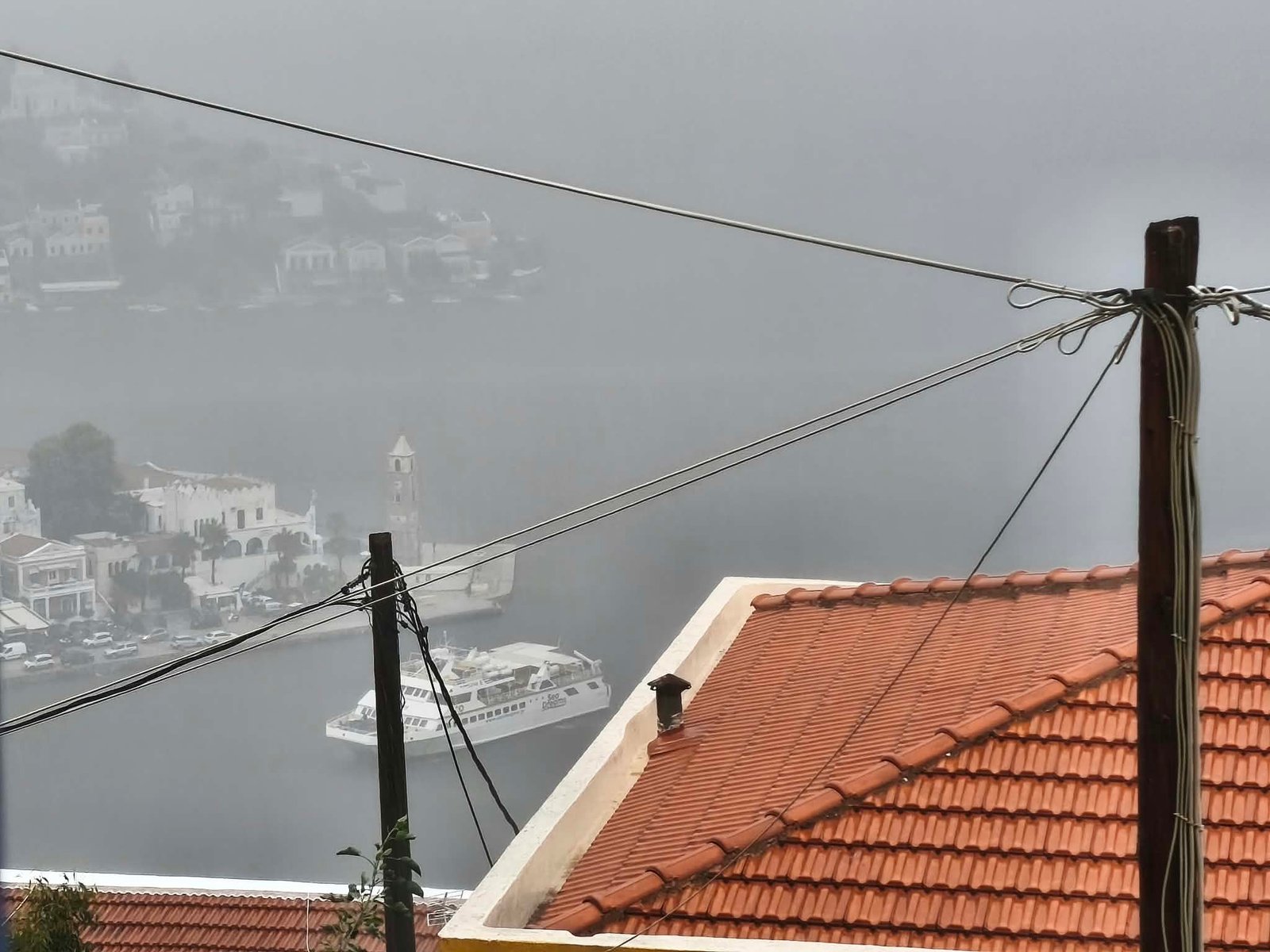
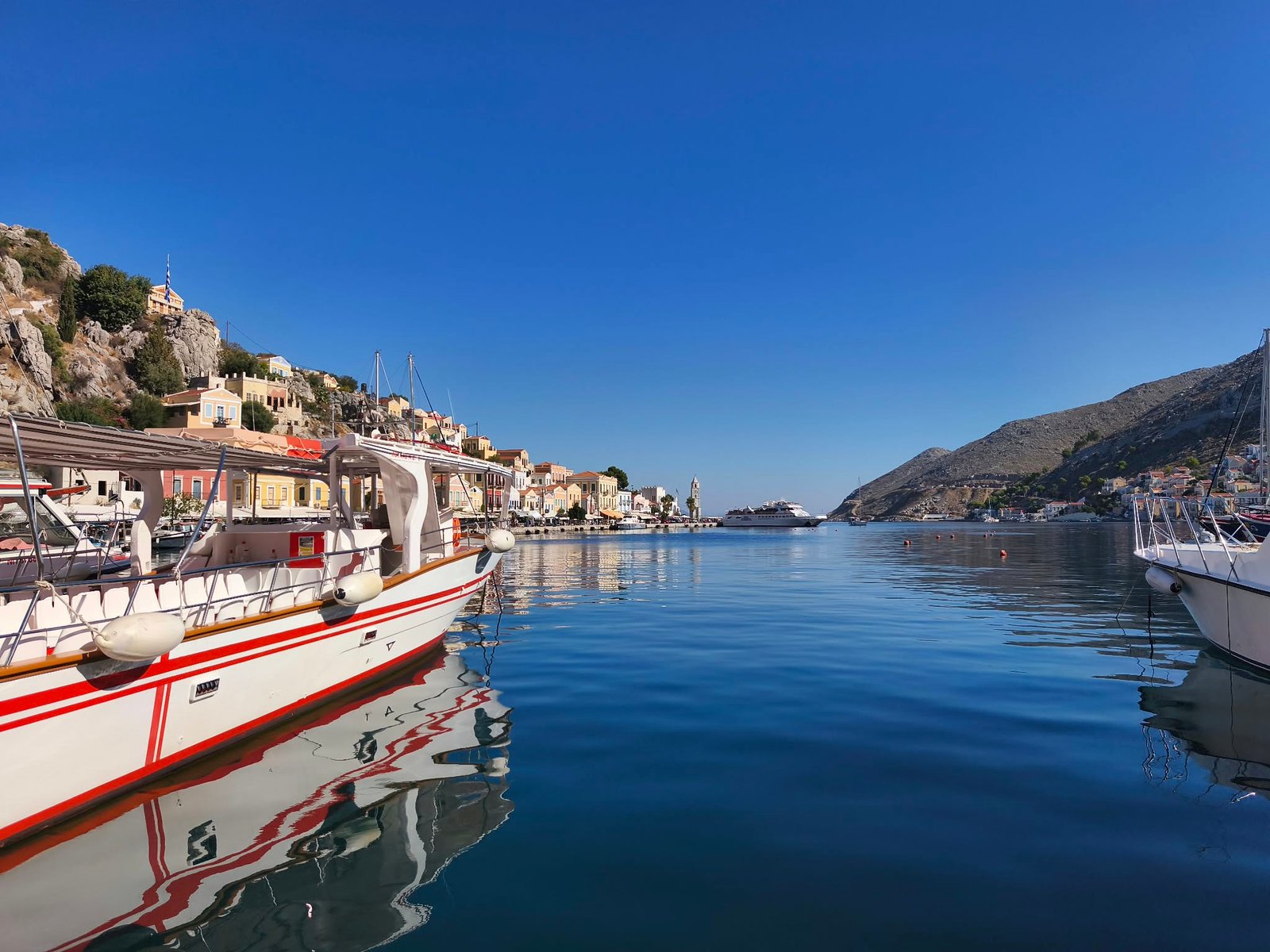
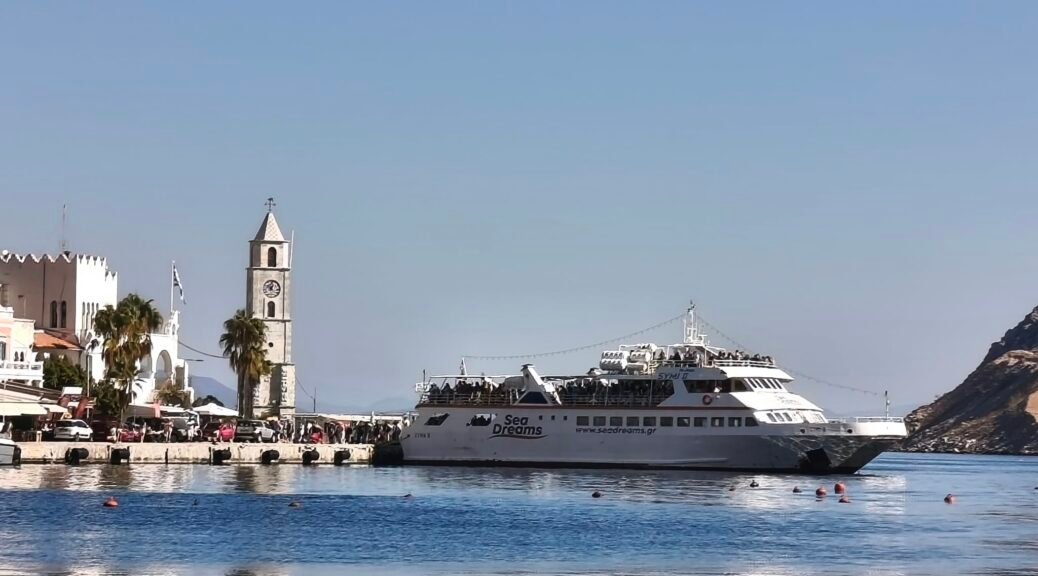
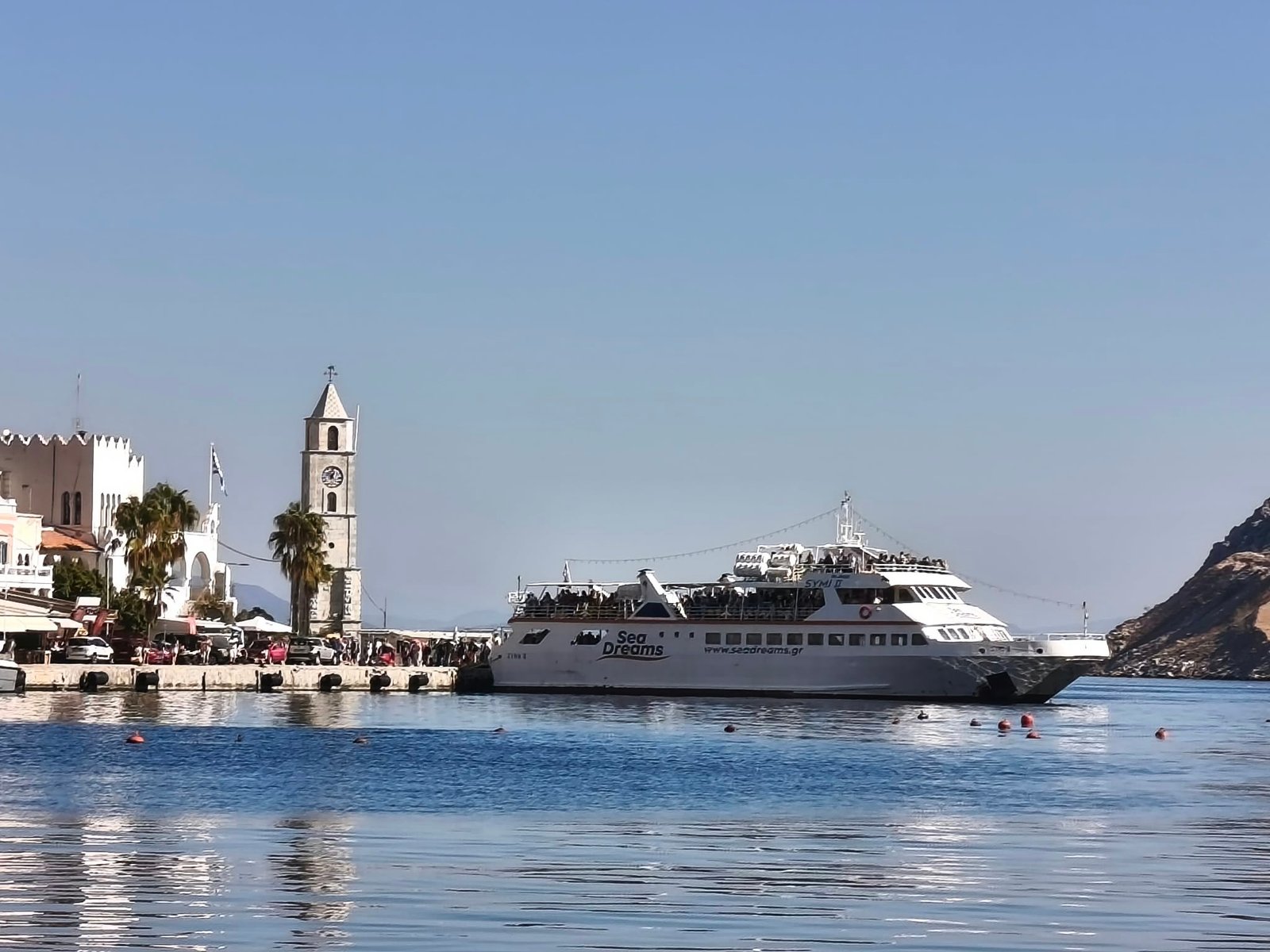
Below in the bay, white tops to the waves, the sea a dark blue, as it often is when windy, but day boats coming in, the Stavros arriving at the clock tower, presumably due to wind. Ferry announcements and horn blares being carried up on the gusts, which slam open windows without warning and manage to enter from the north and south at the same time.
Boats yesterday.
Collard doves perched precariously on the electricity cables, fluffed up more than usual, fewer sparrows foraging in the courtyard, but plenty of bugs caught in the updraft, mosquitoes included.
Inside, there’s no need to put on the fan, not with the window open at the front and the door at the back, creating a wind tunnel that Airbus could test in. Television up in volume a little so it can be heard, roof tiles rattling now and then, the unused air con unit up on the tower vibrating, and the trundling truck, now into its second year, back and forth, dumping rocks into an ever-increasing pile, recently so high, I expected to see ‘Winnie’ buried up to her waste in it, and being direct by Samuel Beckett. Interestingly, that play is called ‘Happy Days’, and the days are happy, despite the wind. I am sure sailors were loving the challenge.
Ironically, as I was working in the afternoon, I had to have the window shut and the fan on, because the workhouse was too warm otherwise, and when I opened the window, everything else slammed, the lightbulb swung, and my map of London (1894) took flight from the music stand.
All this, and we were out to dinner at the Kali Strata so Sam could celebrate his 23rd birthday by cooking for us. Lovely.
It seems to me that so far this summer, we have been getting away with it. We’ve not yet hit 40° in the courtyard, but we’re getting there. I noticed 37° the other afternoon at around four, but the humidity wasn’t too high, there was a slight breeze, and the temperature was just on ‘pleasant, but only for now.’ This morning at 04.45, it’s registering 28°, but after a windy night, doesn’t feel too bad. The office, being little more than a concrete block is still clammy and warm, even at this time of day, and so the fan is on, but otherwise, all is currently bearable. Mind you, I’m one of those who stays in all day working, and if I go out, it’s later in the afternoon or early in the morning, and I’m not seeking day trips of beach days, or even swimming.
Anyway, all this talk of summer and heat soon makes you forget what the colder winters are like, and the other day, I was thinking of the differences, the pros and cons of each season if you like. It’s either winter or summer, with spring and autumn bringing almost incidental changes from one to the other, but there are benefits to both seasons, domestically speaking.
Winter
For example. At the height of winter, the bed is made up with a sheet, duvet and a blanket or two. As spring changes to summer, first, off comes the blanket, and later, the duvet, leaving only the duvet cover or a sheet, and then, by summer, nothing at all. Come autumn, the process happens in reverse. This means the winter offers the chore of making the bed every day, while in the summer, you lie on it, sleep, and get up and get on.
In winter, it’s sometimes a case of sleeping in your clothes too, or at least some of them, for extra warmth. Going out involves dressing, adding layers, a coat, hat, gloves and all the accessories. In summer, I have three shirts and two pairs of shorts to choose from, so that’s easier, and there’s no need to spend time putting on socks and trainers, when sandals will do. So much less of a faff. Winter requires heating and the cost that goes with it, draught excluders at the doors and windows, towels down where the windows and roof leak even when treated and painted, and everything is closed against the cold. Summer? Doors wide open all day and sometimes all night, and the fans running because we don’t have air con. ‘Oh, you must get it!’ people say in that annoying way with the ‘must’ emphasised and said in a way that I find patronising — as if I hadn’t already thought of that, costed it (‘Oh It’s not expensive, you must…’), and decided against it. We have two units, one in my office, which hasn’t been used in 10 years and one pointlessly in the mousandra which we have never used. The fans do for us, thanks. This now being summer for sure, I put the spare one in the bathroom yesterday; as another concrete block, it doubles as a sauna at this time of year.
Summer does bring the worry of fire, of course, especially as we are surrounded by trees, grasses, and overgrown ruins and have no mains water supply with which to deal with any localised issues. We always keep two or three buckets of water on hand, but they are for days when/if the water doesn’t come in and the tank can’t be filled (bank holidays mainly), but you still have to think of precautions. No such worry in the winter. Summer to autumn offers plenty of sweeping practice as the vine, bougainvillea, and others shed dead leaves from June through to November, throw them on the flagstones from where the wind drives them into the house. The warmer months also bring the dreaded Symi spiders prowling and scuttling across floors, walls and ceilings with no warning; ditto the roaches and other bugs. You don’t have to worry about them in the winter so much, which is just as well, as you’re too busy keeping warm.
Still, no matter the temperature, there are no complaints, just an interest in the differences each season brings. Right now, for example, I roll around the house topless all day, with a modesty shirt on hand for when Michaelis comes to read the electricity meter, or Louise comes to sing, and in the winter, I have to type while wearing gloves. (Thermally heated by plugging them into a USB port on the laptop. The wonders of modern invention and cheap online shopping.)
Summer.
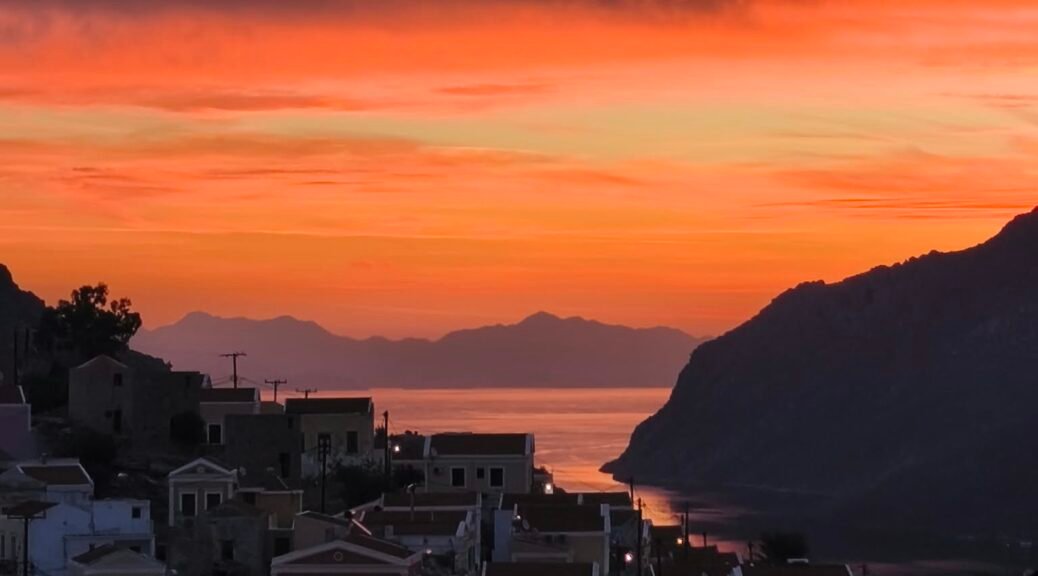
And right now, at 05.15 with the fan running, I’m only my second cup of tea (a constant all year round, tea), and things are just perfect. We’re in for higher temps soon though, ‘they’ say, and I’ll let you know how that goes.
PS. It’s not started well. I just uploaded one photo, went to my folder of Symi photos, selected the one I’d used, deleted it, and the whole folder went, never to return. It was on a data stick, and before you ask, it’s done this before, and no, I can’t get them back, not even with retrieval softwear. Other files went too, like my photos of our Christmas trip last year, though, luckily, I have a copy of them. Ah well. I’ll have to start the collection again.
But first, back to Friday: Down to Yialos to collect a couple of packages. At first, I thought it was quite quiet for eleven or so in the morning, but when I paid more attention, I could see there were more day visitors than I first thought. This might be called the vanishing visitor phenomenon. Several day boats arrive through the morning, park up, and disgorge, and you see lines of visitors on the far side of the harbour trundling towards the main part of town, and a gaggle on the other side disembarking by the bus stop. There, the guide might take their charges to stand inconveniently in the convenient shade of the bus stop, where the bus is just about to reverse in to, and there stand while they listen to the guide’s set patter while holding up the 10.50 from Pedi (via Horio), but they don’t care and they ‘Won’t be long’ as one guide informed the bus driver one day as he chatted on. Then, this lot, too, streams towards the main part of town. Another large group might gather for a while beneath the new cover at the new and improved waiting area by the stop, while another boat arrives on the other side of the port. Then, the party recently released from the Panagia at the Petini port trudge along the road towards town like so many pink and privileged refuges, and as you watch from your place at Pacho’s, you realise that, in the words of Sondheim (almost), ‘Another hundred people just got off of the boat.’ The place is as busy as all get out, and thriving.
But then, two minutes later, you wonder where they’ve all gone.
It’s as if they have been sucked into the ether or backstreets never to be seen again, or have simply vanished, leaving the quay relatively quiet. Of course, they are continuing their tours in shadier parts, like round the back, and in the square, beyond the clock tower maybe, and many will dive straight into a café or taverna, or head off to a beach, depending on time. It still amuses me though, to see at least, what? a thousand people on either side of the harbour, and then, suddenly, hardly anyone.
I had the opposite experience on Friday when waiting outside the post office. One minute, just me sitting there putting on my new sandals just arrived at ACS, while Neil is in the PO collecting a parcel…
Next second, here comes one of those vanishing parties. It appears, passes and within seconds…
Whatever. On to lunch at Trata, and, for me, a simple affair of tuna salad and some gigantes. Neil went for his current fave, Psaronefri (pork tenderloin, this version with hot peppers to your required heat). The gigantes (white beans) were in a tomato sauce as they should be, but this recipe had in it a touch more olive flavour than others I’ve tasted, which elevated the dish, as they say on Australian MasterChef. Very nice, and just enough. Although we were there early, the taverna was soon just about full (by not long after midday), having soaked up some of the vanishing visitors.
As an aside to this pointless post, I have once or twice been asked for my recipe for gigantes, and it’s really very easy, so here’s how I do it.
Buy dried white beans (in plastic bags in Sotiris supermarket and elsewhere). Soak overnight. Change water. Boil until about half done (can take a while, but keep an eye). Meanwhile, make a tomato sauce. Then, bung beans and sauce in slow cooker for a few hours until done. Add some dill at the last moment. Sorted.
I, as you can tell, am not in line to be a MasterChef contestant. However, it is a simple thing to prepare, and I use the slow cooker rather than bake them in the oven because, let’s face it, we can’t afford to use an electric oven around here these days.
Stay tuned for more stunning recipes, like how to elevate a tin of tomatoes, and the pitfalls of making Marmite gravy…
This is where I was heading yesterday when I distracted myself with an attempt to be humorous or satirical, or whatever it is I try to be here. On Wednesday, my attention was drawn to a headline in the Guardian, stating that an Italian village imposes fines on inappropriately dressed tourists. We have heard about some cities charging, for example, cruise ship passengers to sully the walks and waterways of Venice in their thousands, and as long as the income goes to local infrastructure, all well and good. Symi and other islands were/are considering doing the same, I believe. Now, when it comes to the cladding of those visitors, the sensible and catholic Italians have seen the light. Well, they’ve also seen too much bare flesh, wobbly cellulite, misshapen bulges, and chests of all modern genders, passing by Nona’s house on a quiet Sunday afternoon. The villages of Varenna have had enough.
They are not alone.
Ancient photo, but the kind of thing we’re on about: fine for the sea, but not for teh steps.
In the matter of visitor coverage, I’ve noticed a few changes over the years. For one; that the average tourist-cladding has become scanter to the point of scarcity. For a second; that the number of day-trippers making it to the village (usually, sorry to say, the worst offenders) has remained roughly the same; therefore, the number of incidents per wandering population appears to have increased. I have also noticed the timeworn ritual of the Greek male when a scanty-clad passes by, in that conversation, until then about farms, football and family, ceases for the duration of the spectacle as time passes in awed silence. It then resumes on the subjects of females and fornication, and the world is set to rights.
Meanwhile, the high collar and pearls generation can hardly conceal their disapprobation, and clutching their Woolworth’s tightly, fill the air with tutting and ‘Well I never.’ The dedicated beer drinker takes little notice, others laugh behind the bare backs of the scanty-clad, and some take to blank pages such as this to laugh at life without, hopefully, actually insulting anyone.
I once posted a shot of someone’s arse hanging out of her bikini as she passed through the village, but I can’t find it now, and I don’t think I want to.
The kind of spectacle I am talking about is this: Imagine, if you dare, a lady of any years between the ages of teen an ‘think I’m still a teen’ appearing at the entrance to the village sporting nothing but a pair of cocktail party sandals and a bikini, what Vogue calls, ‘an elevated swim essential’, including two-tone triangle tops, supportive underwire bikinis and sleek one-pieces.
Supporting what? A variety of rear hangings, as far as I have observed. In some cases, one catches a glimpse of the lower glutes hanging beneath a top covering, which is just short enough to get the Greek men betting on whether she’s wearing anything beneath. In other cases, we have the full-on arse reveal, the ‘couldn’t care less’ approach, or the ‘I’ve got it, so I’ll flaunt it’ attitude, even among the misguided who haven’t been capable of a good flaunt for many a moon. Also witnessed — and I am not alone in this — is the Thong.
The Thong is not the villain in a Japanese Kabuki (as it might sound, and indeed be), but is a style of swimwear. The Thong, according to people who are not me, comes in a variety of styles, though how anyone can make a style out of a piece of baling twine and half a pocket square is beyond me, as is how they can then charge upwards of €100 for the lack of material. Ladies can decide between the high-wasted Thong, the ‘Shorty’, the small, medium or full coverage Thong. (No-one dares say ‘large’ when it comes to Thong fashion, but everyone knows it means fat). Full coverage is a misnomer, because it doesn’t mean full body, it more or less means full frontal non-cover, but you get the picture: Ursula Andress or Bridget Bardot glistening as she leaves the sea and walks into soft focus, the ladies of the audience cooing in admiration, the men placing their box of Maltesers in their laps.
And so, passes by a free anatomy lesson, often with complete ass cheek and cleavage demonstration on show. The talk next door returns to football and philosophy, and the lads take no notice of what comes next.
(Appropriately dressed) Day visitors enjoying Symi
Teh passes by a middle-aged man who made a pact with Lucifer and exchanged his dignity for a pair of Speedos. No offence to the brand, it is highly successful, and where would our fantasies be without Australian lifeguards and their budgie smugglers? However, when worn by a portly gentleman whose budgie hasn’t seen the light of day since 1989 because of the shadow from the serious overhang above, the Speedo becomes almost a Thong, and we know we don’t like to see those in the village. You can’t actually tell he is wearing anything until he passes by, or rather, until he arses by. As when catching a glimpse of a Thong, the effect on the digestion is similar.
Admittedly, there are some male picturesques who pass, and the sight of a bare male chest is not always unpleasant (as long as it’s Hugh Jackman, Zac Effron or, at a push, Henry Cavill), in other words, blokes can sometimes get away with it. But they shouldn’t.
What should happen is this: An inappropriate dresser appears in the village in a string and a pocket square (or a pair of wren-smugglers if male), and immediately, the officer charged with laying a fine appears from a darkened doorway to demand redress (get it?) and a fine of up to €200, as the village of Varenna is wont to do. Problem sorted; no eyes are singed, no offence is given to the orthodox culture, and, sadly, the lads next door have to think of something else to talk about. The visitor, suitably shamed, dresses, and the municipality takes the money before passing it on to a family member. Or, the cladding-warden might simply be someone with a heads-up who has got there before the authorities, and taken it upon himself to make some naughty cash. It doesn’t matter who imposes the fine as long as everyone is suitably dressed to visit an ancient village considered an historical monument and its churches. With the fine paid, only one question remains:
Where do these people keep their money?
Back on Monday. If you are looking for some reading material this weekend, you might want to browse these 31 books in a special promo. They explore freedom in personal, civic, historical, emotional, or social ways. The theme is intentionally wide, so there is a variety of subject matter among the titles, and because of that, I was able to enter ‘Bobby, a Life Worth Living’ as my contribution. (Click the banner.)
Get your cuppa tea on the go, and settle in. This is part one of a two-day special.
“Italian village to impose fines of up to €200 on tourists with bare chests or in swimwear.”
That was a headline in a major newspaper yesterday. It goes on to say: A fishing village by Lake Como has imposed fines of up to €200 for people who wander around with bare chests or in swimwear, in the latest attempt by an Italian holiday destination to crack down on uncouth tourists.
To start us off, we’re talking at the beach. What happens after is set out in tomorrow’s nonsense. For now, I simply wanted to set the scene.
Obviously, if you are going for a swim on a Symi beach, you will find all the necessary amenities available to you. (Now including disabled access in Pedi and Yiala, with a steaming plastic box nearby in which to change, and, I heard tell, possibly a WC.) As well as this modern addition, there are the wheeled bathing huts into which a lady may step and change into her all-in-one Princess Bathing Suit, before the little old man turns the winch and rattles the box on wheels to the water’s edge, so the lady can demurely slip from hut to water without being seen. Not that she will be, as all the men would have turned their backs so as not to risk becoming amorously inflamed a stray ankle. Those men, of course, are already dressed in their full-body, blue-striped Maillot suits, with caleçons beneath for the daring. They have their straw boaters at a jaunty angle, and with handlebar moustaches waxed, and propriety covered, they are ready for a snifter of bracing seawater.
Took me ages to find photos on a beach as I hardly go to one. This is one I took when we used to use real cameras.
Such bathers take to such waters in whatever attire they might choose, and are free to do so. As for other bathers in Symi waters, they make for a fascinating multiplicity of sights, not only of the bathers themselves, but also of their manner of bathing. Observe:
On one side of the beach, we see the youthful set of young men down from the mountain barracks on a day off from learning how to kill people. There they are, crammed four to a sunbed with two frappes between them, and with much chat and laughter, they study the debutante potential bathing in close proximity. They need not look far, for closer still is the group of wannabe models and influencers from (by way of a non-prejudiced example) Italy. perfectly proportioned in limb, aware of their own beauty and showing every inch of it, apart from the place of most interest to the young servicemen. As ladies of all ages do these days, they keep the upper storey completely exposed to the sun, and to sons of all ages who might stop by for a parley, a point, or a perv. After some penetrating conversation heard by all temporary residents of the strip of shingle, the younger set quieten into slippery masses of coconut-smelling oil, and lie in their own thoughts, enjoying the attentions of the second battalion currently scrapping together enough farthings for one more frappe, as it will buy them more time to carry out their recce and plan their pincer movement.
Pedi beach
Moving along to the next oasis of plastic, canvas, steel and bamboo, we witness the longevity of the northern races. To wit, the perfectly preserved Scandinavians of the middle age practicing the yoga positions learnt that sunrise atop a mountain, heads to the stones, bottoms to the sky, legs to the shoulder, dignity to the wall, a bottle of Special Edition Evian Pure warming beside them, and healthy (organic) fruit ready for the feasting. Beach dress sense? Mildly practical, but contoured to fit only the fit, and show off hours of hard physical work in the gym and various health classes. The middle-aged-and-beyond middle Europeans and British come next with their charming display of big top canvas barely covering the cheap food diet of many years. The landscapes of their homeland have, over the centuries, become ingrained in their physicality. Thus, we witness the rolling hills and deep folds of the valleys, the craggy peaks of past indulgence, and the green and pleasant land of Blake’s imagination, which has become a bilious and pendulous landslip. This is all laid bare with only a little modesty covered, and only then because of a sound early-life training in Victorian ethics.
We may turn our attention to the activity in the water, and there find the various types of aquatic dwellers a summer island attracts. There is the circle of matrons of many nationalities, taking their exercise with feet firmly planted on the seabed, upper storeys in various states of decline exposed or otherwise, but bobbing just above the waterline, and their bodies benefitting from the highly aerobic actions of finger waving the surface as they chat. They stand in marked contrast to the serious bather who is off to complete his third circuit of the entire bay in his (or her, or [preferred pronoun]) daily ritual of ‘Can do so will do.’
Early morning swim
There are many others, of course: The tenacious toddler set free to shatter the peace of strangers and learn for himself (herself, [preferred pronoun-self if old enough]) that investigations can lead to reprisals, and that one’s scream is the greatest weapon against being ignored. There’s the family who have brought plastic lilos, foam tubes and other undegradable excesses all the way from the garden shed via Buzz Airlines, and have set up a temporary market stall of balls, bats, buckets, spades, hampers, tote bags, towels, wet wipes, ‘snax’, bottles, ointments, creams, books, Kindles, newspapers, and loud video games — but very little clothing.
Towards the end of the bay — and this could be any bay anywhere here, there or in our imaginations — we find the one who got it right. The solo (or couple or [preferred pronouns] etc.) who find peace in their own solitude, and who, with respect for their bathing companions, sets himself (herself… ffs, you get the idea) away from the circus in order to find that inner peace so easily offered by an island like Symi, but so easily shattered by the tourist hungry for the same. There, beside the trickle of the sea, an eon-ago-crafted piece of igneous rock provides a free resting place on which to lay a towel. Toes teasing the lapping water’s edge, biodegradable sun lotion simply applied, a large straw hat protecting the head from the sun, and a suitable, nay, respectable attirement of beachwear about the person. Perfect peace, tranquillity, self-absorption, totally content and becoming one with nature, until it is time to leave perfection in search of the rest of the afternoon.
And that’s where the problems started in that village in Italy. That’s where we’re heading with this, and we will head there in tomorrow’s post. From the beach to the catwalk. Don’t be late.